Final Reflections

After learning about the school, the students, the environment, the assessments, behavior guidance strategies, and having hands-on experiences with the children – what lessons have you learned? Be specific, identify 3-5 lessons connected to the topics listed.

I learned a lot of behavior guidance strategies from Mrs. Jung. She taught me to focus on the positive behavior in the classroom before calling out the students that were off-task. She also taught me how to regain the whole class’s attention if they were all off-task. She provided a great example of how to keep yourself calm and talk to misbehaving students in a way that was beneficial to them so they learned something after being talked to so they could do better next time. Another lesson I learned was how important it is for students to be able to have hands-on learning experiences at school. I used to think that having the student quiet and sitting still was very important. Now, I realize that it’s also good for them to able to talk amongst each other and have things to do with their hands while their learning. A third lesson I learned is how beneficial providing scaffolding is to students so they can learn to do things for themselves. I started out the quarter doing everything for them that they asked. After watching how the teacher handled students asking for help, I tried to emulate her. I started asking the students to try on their own first, and then if they needed help, I’d help them. Often, I found they were able to do more on their own than I originally thought. Lastly, I learned that teaching students social skills is a big part of being a Kindergarten teacher. I didn’t realize before how much of a teacher’s time was spent helping students learn how to interact with others. They teach how to problem-solve, work together, express feelings in words, and recognize others’ feelings (theory of mind). Those are just some of the skills teachers help students with besides learning about numbers and how to read.

Based on the Students Evaluation from your practicum supervisor, what are the areas of strength? Be specific.

Between the evaluation sheet and debriefing with Mrs. Jung, I learned that I have strong skills in a few areas. I am good at communicating and engaging with the students when I work with them on worksheets and activities. I always tried to present the information to each student in a way that makes sense to them. I played games with them and talked to them. When I worked with them, I would get down on their level and give them my full attention. I modeled a positive attitude with the students. I was very encouraging to them. I showed a lot of initiative and jumped in when help was needed. Mrs. Jung said that she could tell that I struggled with getting involved with the students and activities at first, but that I had growth in these areas and pushed myself to get more involved through the quarter.

Based on the Students Evaluation from your practicum supervisor, what are the areas of growth that you want to address as your journey to become a teacher? Be specific.

I asked Mrs. Jung what she thought I could work on and she said I should work more on following through with my expectations of students. I noticed that I could improve in this area as well. When students refused to behave, I often had a hard time knowing how to get them to comply. I need to work more on giving them appropriate consequences and establishing myself as someone to be respected. In my own opinion, I think I need to work more on getting to know each child more personally. I would like to talk with them more about themselves and establish more of a relationship with students in the future. I did do this to some extent, but I think I could definitely work more on this. When I have my own classroom, I would like to get to know each child’s family so they see me more as a partner to their learning rather than an authority that just tells them what to do.
Video of Liana Working with Kids

The following is a link to my video. I uploaded it to my Google Drive “Blog Posts” folder and then linked it here. If the link doesn’t work, it can still be accessed in my Google Drive. The activity starts at 1:40, so you can fast forward to that point.

https://drive.google.com/file/d/1Cp0Lq7jYPLnPmt8UA-i-Hr1o06nStrny/view?usp=sharing

This was a small-group reading activity. We had a bag full of cards with CVC words on them. Each child would take a card and read the word, then the next child would take a turn. Some cards had specific directions like, take a card from a friend or give a card to a friend. I didn’t really get to choose this specific activity. The teacher chose it, and I got to lead it.

Before the students arrived, Mrs. Jung explained to me the plan for the Blitz Groups (that’s what they call their reading groups). She also explained how to play the reading game so I was better prepared to lead it. I had also seen the students play a similar game before, so I was familiar with what to expect. I looked over some notes I had taken about classroom management in order to prepare for leading the small-group activity. I used these notes to refresh my memory and think of some techniques I could use for this particular activity.

I think quite a few things went well during this activity. I think it was good to go over names at the beginning because it made us feel more like a group. The students did a great job of being respectful and waiting for their turns. I modeled the behavior I wanted to see in them when they took their cards from the bag, so I made sure to close my eyes and look away. Because of this, I didn’t have to correct them and say things like, “Don’t look in the bag!” because they already knew what I expected.

I noticed that I kept repeating, “What does your card say?” They probably got the idea after a while that they were each supposed to take a turn, so there was no need to for me to repeat this so often. It also might have made them feel rushed. I also noticed that when I would focus on each child reading, I wasn’t very good at paying attention to what the other children were doing at the same time. I didn’t even know the two little girls were looking at my phone so much and holding cards up to it until I viewed the video later!

I would try not to prod them so much by saying, “What does your card say?” every time. It would probably give them more practice developing their working memory and inhibitory control if I didn’t constantly prod and remind them of what to do. I would also try to not let them read the words for friends. A few times one of them would blend the word together or read the word for another student. This takes away the chance for the student who’s turn it was to practice reading. I would also make sure to multitask a little bit better. I need to learn to shift my focus from student to student more often so I can keep tabs on the whole group.

Read Aloud

1. I chose to read “Hello Goodbye Dog” by Maria Gianferrari. I chose this book for few reasons. One of the reasons was that it did not have any tokenism in it. The story took place in an elementary school that had students and teachers of many ethnicities. One reason I like this book is because it’s about a girl in a wheelchair who’s not hindered by her disability or upset about it. It shows how capable she is, which provides a good example to the students. In this story, the young girl was the “doer”. Because of this, it didn’t give off the idea that people in wheelchairs should be pitied, but instead that they are capable humans.

2. One thing that impacted my choosing of this book was that it gave the opportunity to teach about therapy dogs. (In the story, the girl takes her dog to therapy dog school to get him certified so he can go to school with her). Another reason I chose it was because it gave the opportunity for the students to hear a story about a girl who is in a wheelchair. I was hoping a story like this would help them develop some empathy and an understanding of how people in wheelchairs are just like people without wheelchairs.

3. I read the book to myself to prepare for the read aloud, that way I didn’t get surprised by anything and I could read it more smoothly. This also helped me take note of any words or ideas that might stump them. I put sticky notes on the parts of the book that I wanted to talk about more, explain more, or ask the kids a question about.

4. I used a few strategies while reading the book aloud. Before starting to read, I asked a question about what they thought the book was going to be about. This helped them to become interested and engaged. The book used the phrase “Moose put on his breaks” a lot. I wasn’t sure if the kids would know this was a creative way of saying that he quickly halted to a stop. Because of this, while reading, I asked the students what they thought that meant. Then, one of the students explained it for everyone. I also brought their attention to a rhyme in the story. I read all the rhyming words together and asked what they noticed about the words. They answered excitedly, “They rhyme!” At the end of the story, I explained how a therapy dog can provide a comfortable companion for children learning to read. This (hopefully!) helped explain why the dog in the story was allowed be at the girl’s school.

5. I learned that I really like reading stories to children! I also learned that the sticky notes on pages are a helpful tool to remember where you wanted to add something to the story. I also learned about how asking a question before reading the story can help get them engaged. I learned a lot about how to build a balanced library as well, making sure that all students and lifestyles are represented.

Curriculum and Common Core

The Kindergarten teacher I am working with uses the following curriculums in her class:

National Geographic Reach for Reading is used for the reading/writing standards.

Bridges in Mathematics is used for the math standards.

Foss Next Generation is used for the science standards.

I have briefly looked over the National Geographic curriculum. From what I’ve noticed, the students use a lot of worksheets from the workbooks. The worksheets include tracing letters, identifying words that start with particular sounds, and some reading. Every morning, the teacher writes a message on the board for her students and then reads it to them. Sometimes it has missing words or punctuation for them to fill in. She teaches how to write uppercase and lowercase letters. Each student uses their own whiteboard and marker to write with. They have a sight word slideshow that she projects and they all read the sight words together.

According to OSPI’s webpage, “The standards require a practical, real-life application of knowledge that prepares Washington students for success in college, work and life.” They were developed so the requirements and expectations would be the same throughout the country which would make it easier for students who moved and easier for collaboration between teachers and schools. They were adopted by Washington State in 2011. Teachers are to be given guidance on how to implement Common Core in their classrooms. For the implementation of the Common Core standards, teachers and school leaders needed to make sure their curriculum was aligned with the Common Core standards. They hoped it would improve the quality of teaching. One way they are being implemented in Washington state is through “Bridge to College” courses. This course is designed for 12th-grade students who are performing in reading and math at the 10th-grade level. After taking this course, they should be prepared for college coursework. The “Bridge to College” course is based on the Common Core standards.

Positives of Common Core:

The Common Core helps prepare students for college and future work.

It helps students learn the subjects on a deeper level than if the students were given many topics to learn about.

They spread the subjects over many grades so students get exposure to them over time instead of just in one grade.

It teaches students multiple ways to solve math problems.

It helps them think more creatively about the math problems they encounter which can give them more excitement about learning it. It can also help them see math in different ways instead of just learning about one method with a right or wrong answer.

Negatives associated with Common Core:

No one really knows how much a of a benefit the Common Core actually provides to students.

They don’t provide any instructions on how the states should implement it or what to do with the funding they provide for it. Every state can implement the common core however they want, which leads to a problem similar to the one they had before.

According to some people, local schools should decide what their students learn, not the state. One person asked, how can the federal government know better how to educate students than they do locally?

It’s more difficult for parents to help their kids with math because it has changed a lot.

Resources and Videos:

Why Students in the US Need Common Core Math

Common Core: 101 – 5-Minute Breakdown with Dr. Duke Pesta

ABC 10 Studies the Pros and Cons of Common Core

What is the Common Core? The Controversial Standards Explained

Common core: A Positive Transformation

K12.wa.us. (2019). Bridge to College Courses. [online] Available at: http://www.k12.wa.us/CurriculumInstruct/BridgetoCollege/default.aspx [Accessed 25 Feb. 2019].

K12.wa.us. (2019). Common Core State Standards. [online] Available at: http://www.k12.wa.us/CurriculumInstruct/CCSS/default.aspx [Accessed 25 Feb. 2019].

Cultural Competence

I just wanted to say first off, that I don’t think that a person’s ethnicity says anything about them individually. People can’t tell, just by looking at a person, what their cultural values are. I think it’s important to get to know each student/person individually and understand where they’re coming from.

That being said, I am aware of some aspects of certain cultures that are common among people belonging to that culture. However, I understand that just because a person is from a certain culture, doesn’t mean that they agree with or subscribe to everything or anything that’s a part of that culture. I feel that a lot about a person depends on the family and their personal views and the individual as well.

Recently, I have been learning more about other cultures and the way they view intelligence and a comfortable learning environment. I have read things about how African American children might have more of a kinesthetic intelligence. This could be because they value this in their culture. (Trawick-Smith, 2018, pg. 372). Some children from Japan might be more logical-mathematical and spatially intelligent. (Trawick-Smith, 2018, pg. 373). I have also read about how African American children might enjoy more of the social aspect of learning and they possibly learn better with others. (Trawick-Smith, 2018, pg. 252). At the same time, “Children of Chinese or Chinese American families often prefer relatively direct adult guidance in quieter, less active learning settings.” (Trawick-Smith, 2018, pg. 252).

While in the classroom, I noticed a few examples of culturally responsive teaching. During the morning meeting, the students went around the circle and asked each other if they preferred rain or snow. Each child got a turn to ask the question and answer the question. I thought this was a good example of building trust and communication skills amongst the students in a social setting. I’ve also seen the teacher ask children to work together often. Sometimes they have to talk and come up with the answer to a question together. The teacher also provides times in the day for students to work on their own. Mrs. June incorporated oral traditions and music into the lesson by singing a song about pennies and another about the month of February to help the students remember what they learned.

Sources:

Trawick-Smith, J. (2018). Early childhood development. 7th ed. pages 252, 372-373

Guiding Behavior and Classroom Management

1. Management Strategies:

A. After the morning activity, the teacher calls all students over to the carpet for group learning. While at the carpet, she talks in a very quiet voice. She does this so the students have to be very quiet in order to hear her. I think this is a great idea because it calms the room and prepares them to listen.

B. Another management strategy the teacher uses involves transitions. In order to get students’ attention when a transition is coming, the teacher will say, “Eyes up!” and all the students know to say it back, put their hands up, and give her their attention.

C. She also does a great job of making sure to explain to students what she would like them to do and why. One time she told a few girls to not walk through a puddle. They started walking through it and she asked them to go back and try again (this time walking around the puddle). After they walked around it, she explained that walking through puddles makes your socks wet and that is uncomfortable.

2. Phrases and Techniques to Guide Behavior:

A. The teacher does not have any “broken records”. The closest thing to a “broken record” is when she reminds students of A.I.M. which is the school’s goals for students. A.I.M. stands for “Always be respectful. I solve problems. Make responsible choices.” She reads those goals to students almost every day, but I don’t really think that is a negative. I think it’s good to remind them of the behavior goals.

B. A technique the teacher uses often if pointing out respectful behaviors and responsible choices. She says things like, “I can tell Samantha is ready. Her eyes are looking. Her ears are listening.” Or, “Troy is waiting patiently for his turn at the water fountain. His hands are still at his sides.”

3. Undesirable Behavior:

A. From what I’ve seen, Mrs. June finds distracting behavior undesirable. A lot of times, when students are distracting other students, Mrs. June redirects them or tells the students being distracted to move to a spot where they can focus.

I don’t think all students have the same expectations around their behavior. Some students stay seated during the entire lesson and they don’t talk to their neighbors. Other students sit in spots they know they’re not supposed to sit in and sometimes even go to other areas of the classroom. As long as those students don’t distract the ones staying seated, Mrs. June usually lets them sit where they want. It would take too much learning time away from the students paying attention if the teacher used her energy to continually redirect the others. She told you have to choose your battles. Even though she wants all of them to be learning and paying attention, as long as those students aren’t distracting the ones being respectful, she continues her lesson.

Yes, some students do get called to task more often than others.

The ones that are verbally disciplined are usually distracting others, making noises, or are out of control of their bodies. Like I mentioned above, a lot of the time she talks to the students, though, instead of just calling them out.

From what I’ve noticed, she uses the same language for girls and boys.

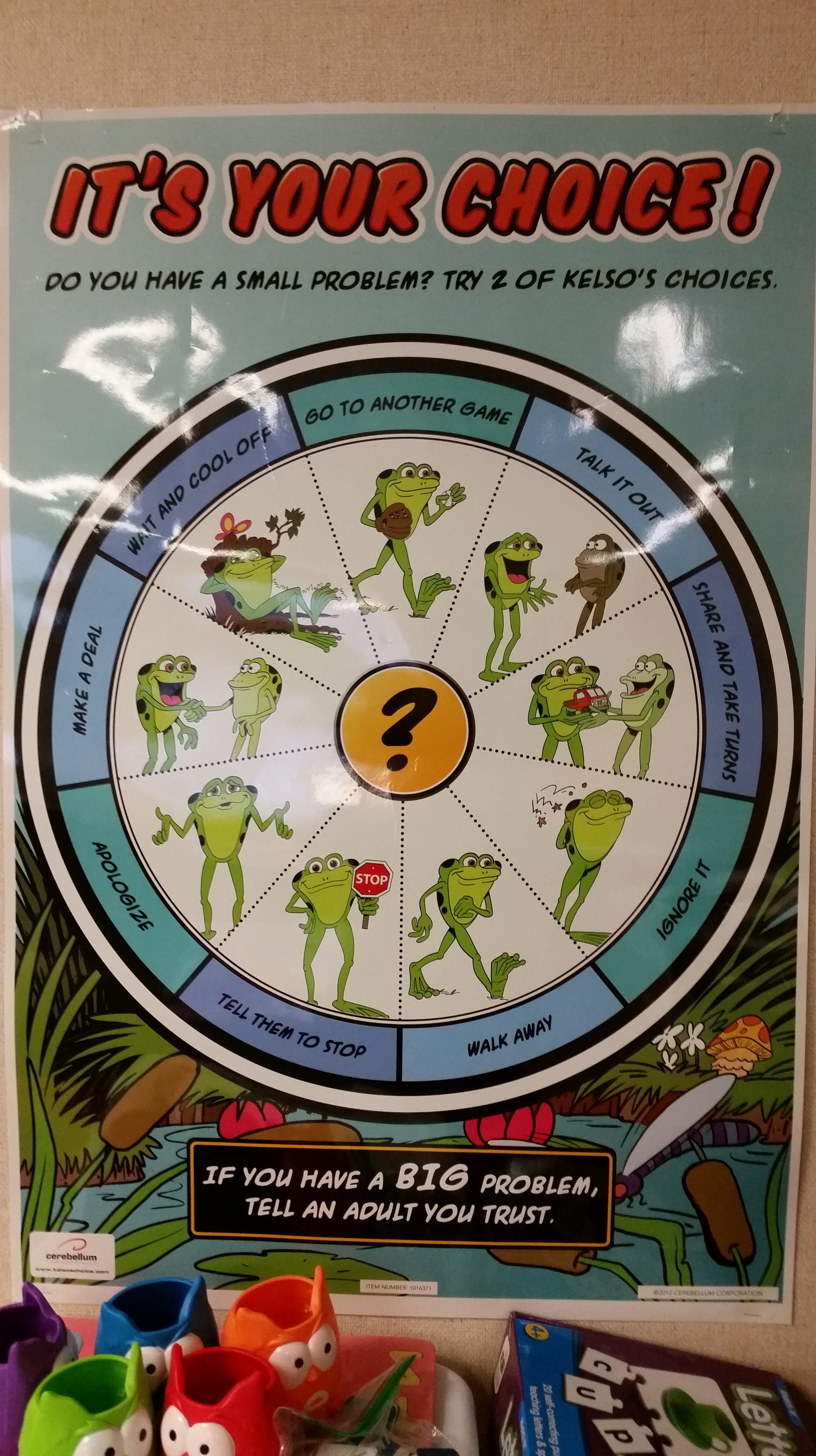
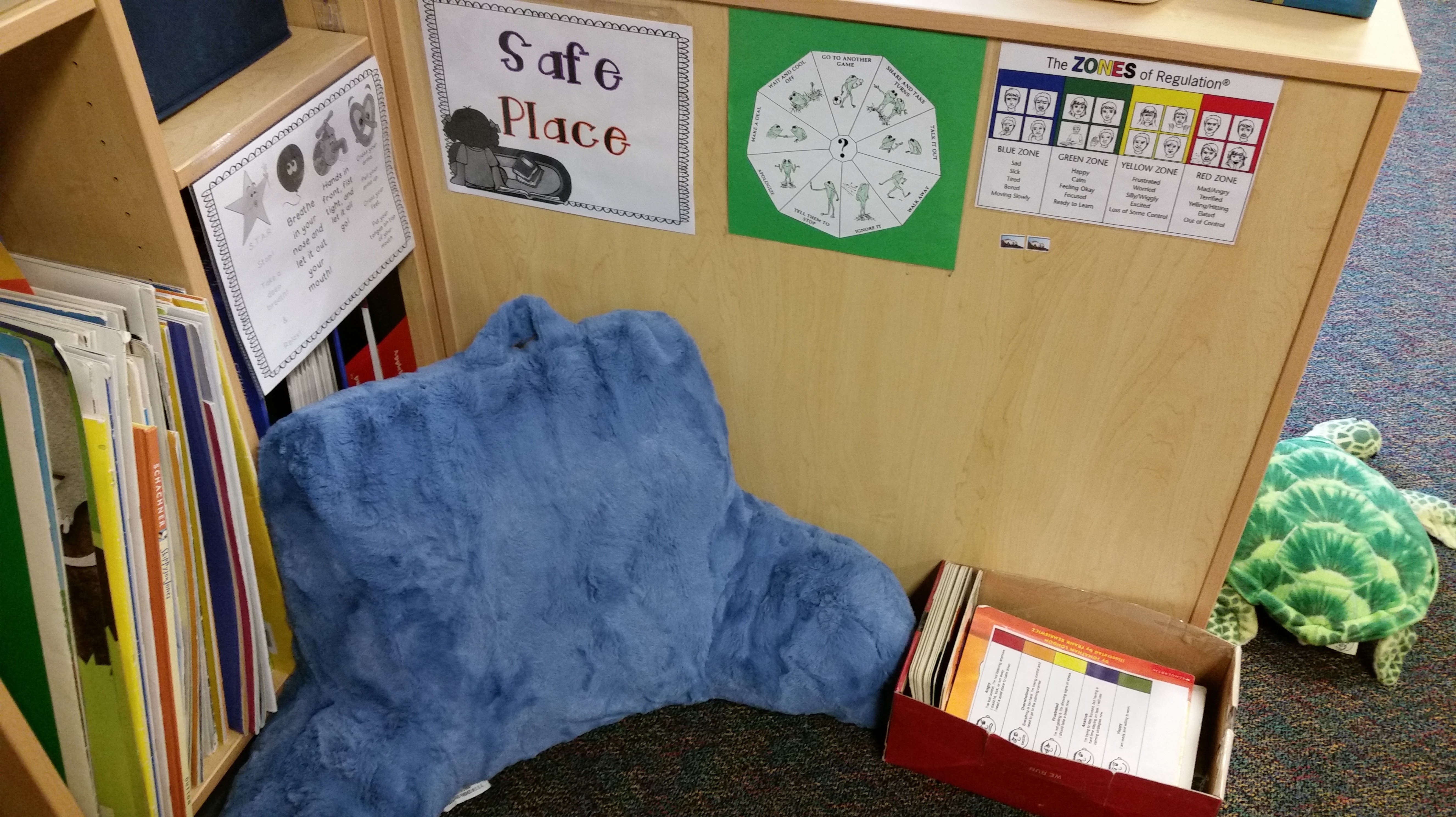
Calming Corner/Safe Place
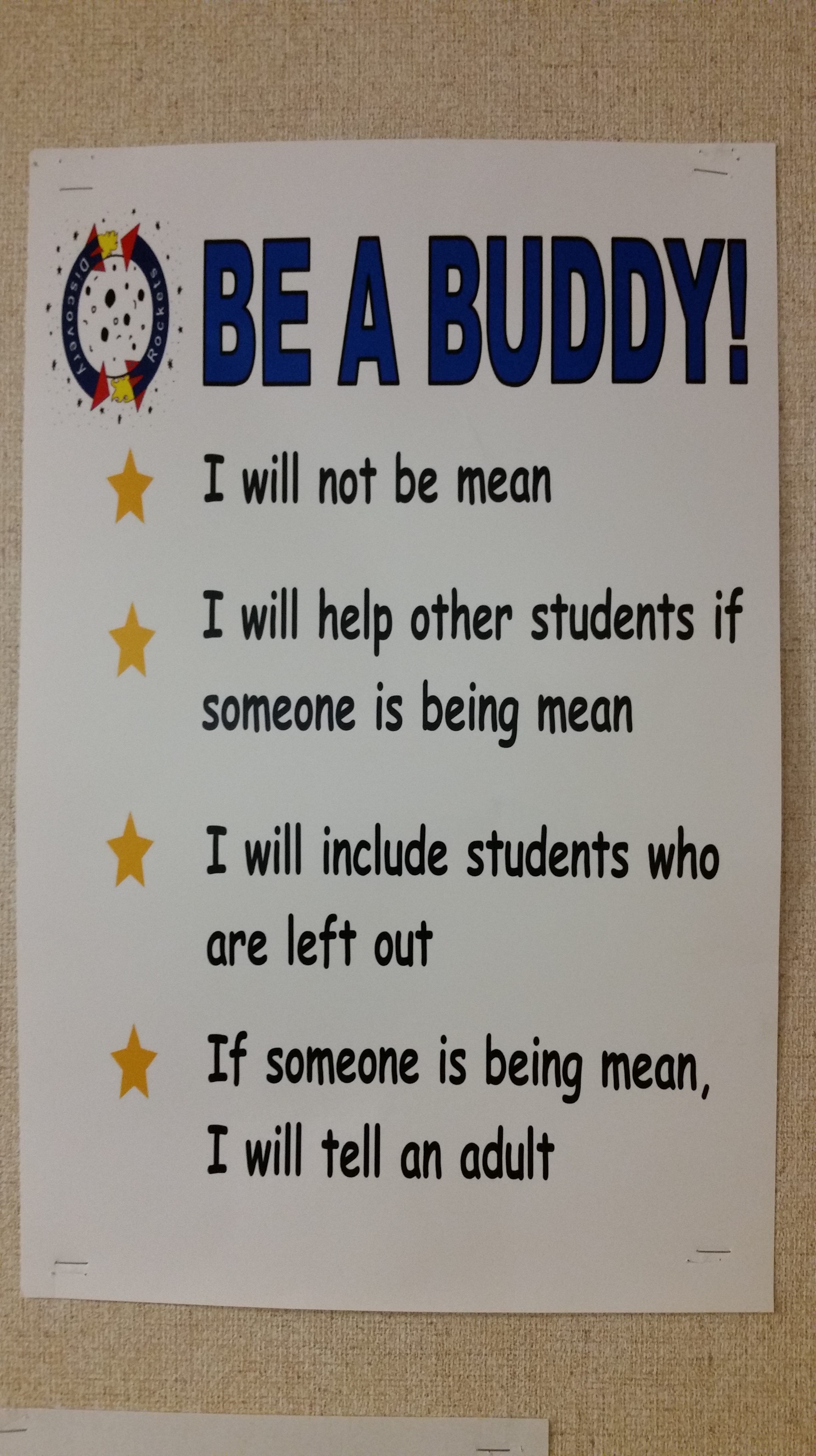
School Goals for Students


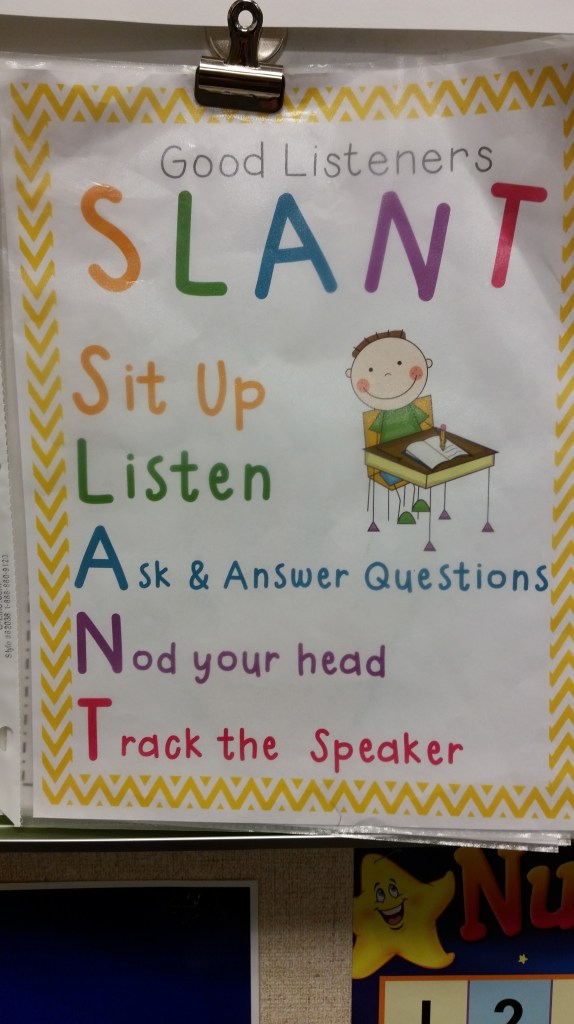
Classroom Environment


Relationship

Through using the “School Visit Observation Guide” provided for this activity, I noticed some examples of relationship-building and respect being cultivated in the classroom. I also noticed an area for improvement in the classroom. The first thing the teacher says to her students every morning is “Good Morning” and she greets them each by name. I think this is a great way to build relationships because it demonstrates a community of respect which is often of great cultural importance. I also noticed how the teacher used the morning meeting time to build a rapport and personal connection among the students. They went around the circle and each explained something they did that weekend. Mrs. June waited patiently for each child to start (sometimes they thought a long time before speaking) and she waited until they were done without limiting their talking time. I thought this was a good way for the students to practice using their words and to learn about each other. The last example I’ll share took place after story time. Everyday, one child is assigned to observe their peers, recognize respectful learning behavior, then hand out stickers to those that exhibited respectful behavior. When they give out the stickers, they explain what that child did that was positive. This encourages students to use trust-building language with each other and also promotes good relationships.

I would have liked to see more team projects where the students had to talk between themselves about what they were learning. In class tonight, one of the Education Practicum students brought up a tool that the teacher she works with utilizes. She said the teacher asks her students to talk to each other and then come to an answer and report it back to the class. This is one way they could work on team-building and build more trust within the classroom.

Results

I noticed a few examples of the results of the teacher’s encouragement and teaching about problem-solving. Both examples occurred during free choice activity time. I went over to the dollhouse and asked the students what they were doing. One student replied, “We’re watching Spidergirl and Supergirl ‘cuz she wanted to watch Supergirl and I wanted to watch Spidergirl.” I asked, “How did you solve that problem?” The girl replied, “The Mom (played by another child) told us there’s a show with both, so we’re watching both.” In this example, the student was able to explain what she was working on and connect the situations to learning she had done. This is really encouraging because it shows that the teacher is having an impact and that those students are able to connect what they’re learning to real-life situations. They’re learning how to be their own problem-solvers and respect others’ desires. I also noticed the teacher talking about the importance of teamwork and getting jobs done together. While they were cleaning in another part of the classroom, I heard a student ask, “Who needs help?” Because the teacher models this attitude of cleaning up together and helping each other, the students learn from that and demonstrate it in their actions.

I would have liked to see a few more things connected to student rigor in the classroom. I would have liked to see more opportunities for the students to ask questions, especially during the story book reading. I also would have liked to see more posters in the classroom promoting perseverance and grit. My cousin is a teacher, and her classroom has a poster about making mistakes and how they are opportunities for trying again in a different way. Posters like these can help students understand the idea of not giving up.

Discovery Primary School Mission/Vision

Discovery Primary School Mission:

The mission of Discovery Primary School is to provide a safe and positive learning experience.

Discovery Primary School Vision:

We, the staff of Discovery Primary School, are dedicated to providing our students with the academic, social, and physical skills required to meet their fullest potential. In partnership with families and the community we seek to provide the foundation for students to acquire the competence and responsibility to become contributing members of society and lifelong learners.

What I noticed:

I saw a strong focus on the development of social skills while in the school. One example took place during morning meet and greet time. During each child’s turn to speak, they would hold a stuffed turtle. Mrs. June was explaining how the turtle should be passed nicely and with respect. One student replied, “It’s just a stuffed animal.” To which Mrs. June said, “But we still need to treat it with respect. We treat everything with respect and this stuffed animal is an important part of our classroom.” Another example of this occurred during the morning meet and greet as well. One child had finished introducing herself and another child started laughing at her name. Mrs. June explained that we don’t laugh at others’ names because names are an important part of a person.

I also noticed the teacher putting a big focus on students acquiring “the competence and responsibility to become contributing members of society.” She encouraged students to make responsible decisions and make choices for themselves. She would often ask students to make responsible choices and explain why they should make that choice instead of just telling them what to do. For example, the classroom had a foldout firetruck, but only three students could play in it at a time. Mrs. June explained how the children who went first needed to keep the firetruck nice so the next group could enjoy it, too. One aspect of the classroom that I really admired was how student-focused it was. There were multiple times throughout the day that students had options as to what they wanted to do. I thought this was a great way to start helping them learn how to make decisions on their own.

Demographics for 2019:

Total Students = 647

Boys = 55.2%

Girls = 44.8%

ELL Students = 24.3%

SPED = 7.7%

Free or Reduced Lunch = 49.3%